Padel vs squash: a squash player's guide to crossing over
Padel vs squash comes down to what the walls are for: in squash the front wall is the target, in padel the walls act on the ball only after it bounces. Padel adds a net, doubles, tennis scoring, and an underarm serve — yet squash players cross over faster than almost anyone.
Padel vs squash at a glance
| Padel | Squash | |
|---|---|---|
| Court | 20 × 10 m, glass and mesh enclosure, net in the middle | 9.75 × 6.4 m, four solid walls, shared space |
| Format | Doubles (singles courts exist but are rare) | Mostly singles |
| Scoring | Tennis-style: 15–30–40, six-game sets; golden point or advantage | Point-a-rally to 11, win by 2, best of 5 |
| Serve | Two serves, underarm, after a bounce, at or below the waist | One serve, above the service line on the front wall |
| Ball | Tennis-ball size, slightly lower pressure | Small rubber ball with very little bounce |
| Walls | In play after the ball bounces | The target of every shot |
| Racket | Solid perforated face, no strings, max 45.5 cm | Strung frame, max 68.6 cm |
The walls: target in squash, second life in padel
A legal squash shot hits the front wall above the tin — 48 cm high, 43 cm in pro events — and below the out line. The side and back walls create angles, but the front wall is non-negotiable.
In padel the ball must bounce on your side of the floor before it can touch the glass, and you play it off the rebound. You can even hit a ball that has beaten you into your own back glass so it flies back over the net — a legal, common defensive shot. Into your own wire fence before it crosses, though, and the point is gone. If you're new to padel, our intro guide covers the basics.
How scoring works in padel vs squash
Squash scores every rally: games to 11, win by two, best of five, one serve only.
Padel borrows tennis wholesale — 15, 30, 40, game; six-game sets; usually best of three. At 40–40 the professional rule is a single deciding golden point, but many clubs still play traditional advantage, so agree before the first ball. The serve is nothing like squash: bounce the ball behind the service line, strike it at or below waist height, send it diagonally into the opposite box — and you get a second serve.
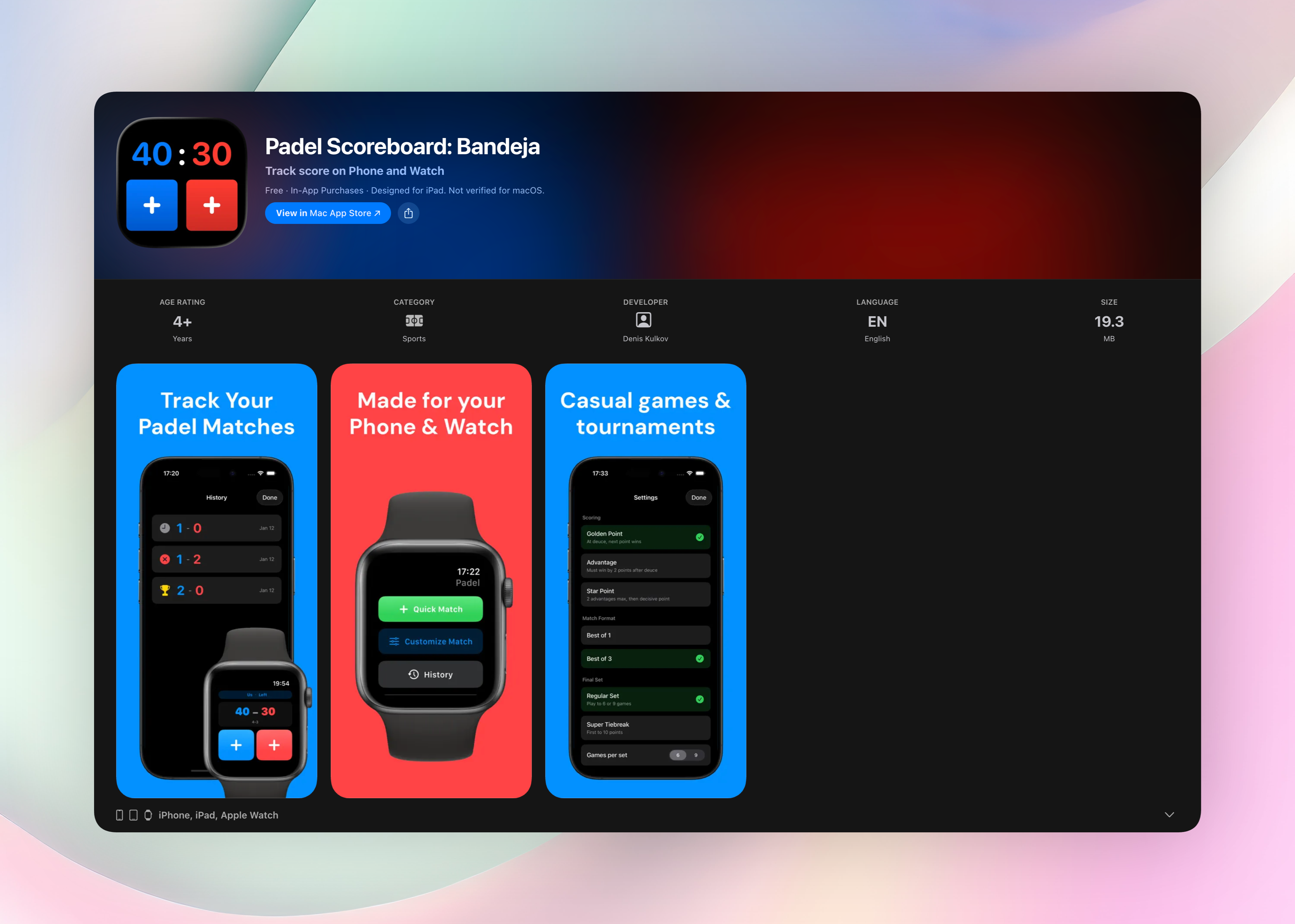
The scoreboard is what squash players fumble longest — the score climbs 15, 30, 40 instead of 1, 2, 3. If you try padel, Padel Scoreboard, a padel scoreboard app for iPhone and Apple Watch that tracks match scores, keeps the sequence and set count straight while your attention is on the glass. The format is pure tennis — padel vs tennis covers that comparison.
Ball, racket, and why rallies feel different
A squash ball is dense rubber with little bounce even when warm; the game is built around making it die in a corner. A padel ball is tennis-ball sized at slightly lower pressure — it stays lively and sits up off the glass. Pace is cheap: whatever you crush comes back off the wall as a sitter for the net players.
Squash uses a long strung frame built for wrist speed; a padel racket is a solid perforated face with a foam core — made for blocking, volleys, and placement, useless for squash-style flicks.
Fitness: the singles grind vs doubles bursts
Squash is the harder workout, and it isn't close. Singles squash means covering the whole court alone, lunging out of every corner and recovering to the T. Padel is doubles: you cover roughly a quarter of the court, movement comes in short bursts with rest between points, and the artificial turf is kinder to knees and hips.
What a squash player has to unlearn
- Taking everything early. Squash rewards cutting the ball off to hold the T. In padel the percentage play is often letting it pass and hitting off the glass.
- The full swing. Off the back glass a big backswing arrives late; compact blocks and the bandeja — a controlled overhead — do the scoring work.
- Hitting low and hard. Flat kills feed the opposing net pair. The lob is an attacking shot in padel, not an escape.
- Living in the back corners. Squash is won deep; padel points are won at the net, and the pair holding the net usually holds the game.
Why squash players pick padel up fast
Squash hands you the hardest padel skill pre-installed: reading a ball off a wall. Tennis converts have the strokes but flinch at rebounds for months; you'll track them from day one. Most squash players are competitive at club level within a few sessions — the curve runs through the serve, the swing size, and patience. For the other common crossover, padel vs pickleball compares that pairing.
FAQ
What is the main difference between padel and squash?
The role of the walls. Squash players share one court and every shot must reach the front wall; padel players face each other across a net, and the walls act only after the bounce. Padel is also doubles with tennis scoring; squash is mostly singles to 11.
Is padel easier than squash?
Easier to start and sustain, yes. The underarm serve, livelier ball, and doubles coverage mean real rallies in the first session, and it's far kinder to the joints. The tactical side still runs deep — patience and lob selection take years.
Can you play padel as singles?
Singles courts exist — narrower, at 20 × 6 m — but they're uncommon. The standard court and its tactics are built for doubles, so expect to play with a partner.
Do squash skills transfer to padel?
Wall reading, anticipation, and tight-space racket control transfer directly, which is why squash players adapt faster than most. The main retraining: swing size, letting balls pass to the glass, and the underarm two-serve rule.
Free Padel tools
- Court Time Format GeneratorChoose your booking length, warm-up and pace to get a practical padel scoring format, finish-time range and fallback plan. It also explains how many sets in a tennis match usually means best of 3.
- Padel Americano GeneratorBuild a padel americano or Mexicano draw from player names, courts and points per round. Get printable pairings and individual standings in your browser.
- Padel Court Dimensions CalculatorUse standard or custom dimensions to calculate a padel court's length, width, playing area, perimeter and net measurements.