Padel strategy: why the net wins and how to take it
Padel strategy comes down to three decisions: take the net, move as a pair, and use the lob to win the net back when you've lost it. On a walled 20-by-10 court, position beats power — the pair at the net wins most points. If the basics are still new, start with the beginner walkthrough.
Padel strategy starts with winning the net
The net wins in padel for the same reason it wins in doubles tennis, plus one: the glass. From the net you can volley down, angle the ball off the side glass, and take time away from your opponents. From the back, your options shrink — anything you drive hard from 10 meters behind the net arrives at a comfortable volleying height for the pair in front of you.
The back court is also weak because of geometry: a ball struck below net height (0.88 m at the center) has to travel upward, and an upward ball reaching the net pair is a free volley. The whole tactical game is a fight over who has to hit up.
The plan on every point: at the net, hold it; at the back, don't try to win the point — win the net first.
Move as a pair, not as two singles players
Good padel positioning is pair positioning. Imagine a rope three or four meters long tied between you and your partner: one shifts left, both shift left; one gets lobbed and drops back, both drop back. The two shapes that lose points are the diagonal split — one player at the net, one at the glass — and the frozen pair that leaves the middle open.
The middle matters more than the lines. On a 10-meter-wide court there isn't much space down the line, and the side glass punishes narrow angles. Most clean winners at club level go through the gap between two players who never decided whose ball it was. On middle balls, the player with the forehand there usually takes it — and either way, somebody calls it.
The lob is the core weapon
The lob is not a desperation shot in padel — it's the main tool for taking the net. A deep lob forces the net pair to retreat or hit an overhead off the back foot; either way, the geometry flips. Hit it and walk forward together. A lob you don't follow to the net is a lob wasted.
Two details make lobs work. Depth beats height: a lob that dies in the last two meters of the court is hard to attack even when it isn't very high. And direction matters: lob over the backhand shoulder when you can, because the standard answer — the bandeja — is much harder from that side.
Expect lobs back — a good point often runs volley, volley, lob, retreat, counter-lob, and the pair that keeps its shape through those transitions wins the fight for position.
Left side vs right side: who does what
For a pair of right-handers, the two sides carry different jobs:
| Area | Right side | Left side |
|---|---|---|
| Typical role | Consistency and setup | Finishing and aggression |
| Middle balls | Backhand | Forehand — takes most smashes |
| Signature shots | Block volley, chiquita, deep return | Smash, víbora, attacking volley |
| Mindset | Keep errors low, build the point | Take the ball early, end the point |
Neither side is better. The left-side player hits more winners because their forehand covers the middle, but they only get those balls because the right-side player kept the point neutral long enough to earn them. With a left-hander in the pair, most put the lefty on the right so both forehands live in the middle.
When to let the ball go to the glass
Beginners take every ball before it reaches the glass. Stop. The back glass is a second chance: a fast, deep ball that has beaten you rebounds back toward the court slower than the original shot. Playing it after the glass gives you an easier ball and a half-second to reset.
The working rule: pace and depth off the glass, touch before it. If the ball is fast and will reach the back glass at knee height or higher, let it pass and play the rebound. If it's slow, dipping, or angled to die in the corner, take it early — there won't be a playable rebound. Balls that clip the side glass then the back glass rebound toward the middle; give them room and they often come to you.
Play the score, not just the ball
Points are not equal. At 30-30, at deuce, and on game points, tighten the percentages: more lobs, first serves in, everything through the middle, where your errors are cheapest and theirs are easiest to force. Save the risky smash off the side glass for 40-0. Many matches now play a golden point at deuce — one sudden-death point, with the receiving pair choosing which side returns — while others keep traditional advantage scoring; the full scoring system is worth ten minutes if that's new. In advantage scoring you can gamble a little at deuce. In golden point you can't.
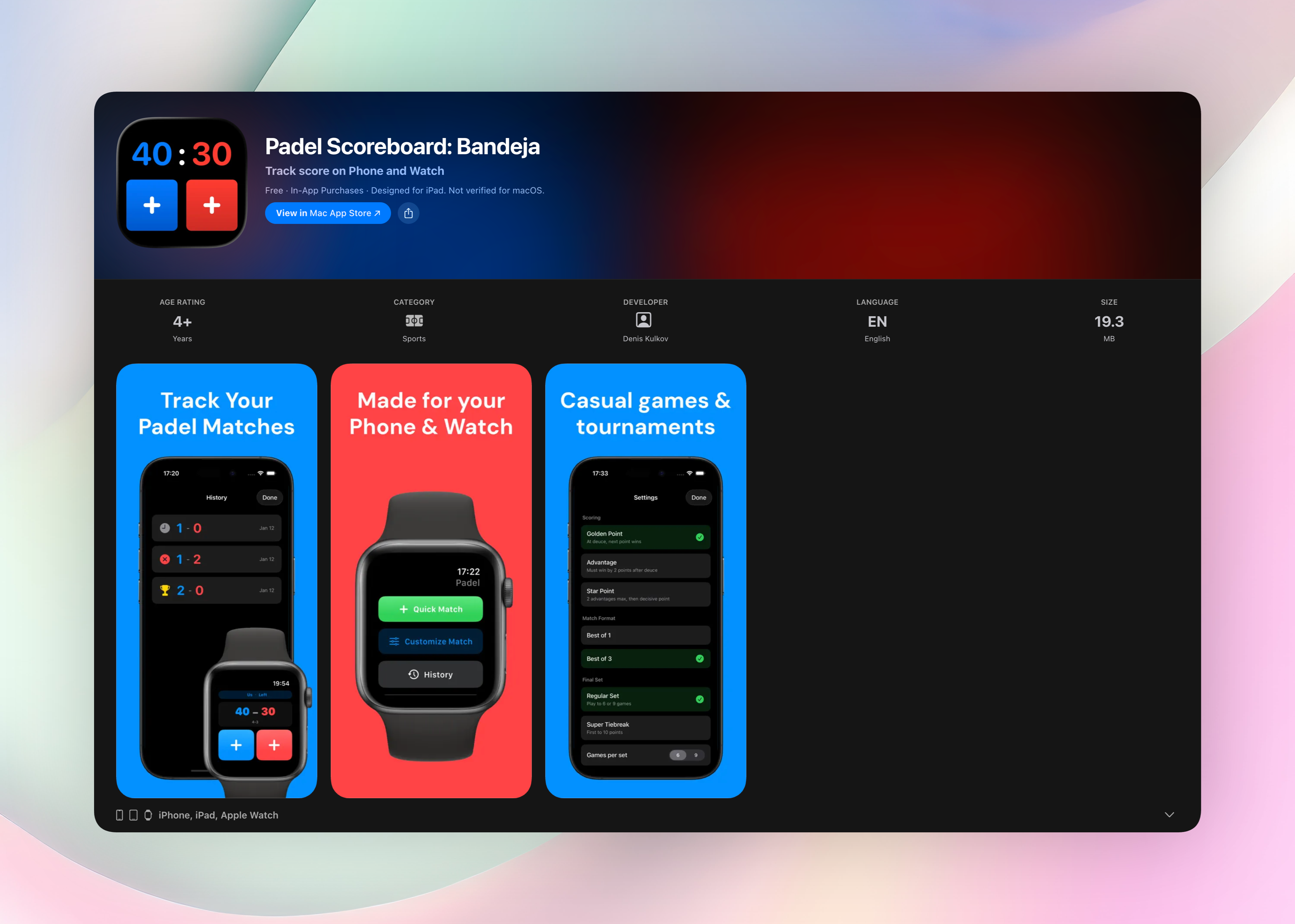
Score-aware padel tactics only work if you actually know the score, which is harder than it sounds three lobs into a long game. I track matches with Padel Scoreboard, a padel scoreboard app for iPhone and Apple Watch that tracks match scores, so the game state is a glance at the wrist instead of a debate at the net.
Three tactical mistakes every beginner makes
Trying to win from the back with power. The glass returns your best drive, and hard flat balls sit up at volleying height. From the back: keep it deep, keep it low, or put it up. Most padel tips for beginners focus on technique, but this mental shift — back court means build, not finish — wins more matches than a better smash.
Not following the lob. A deep lob with no advance behind it wins you nothing: you forced them off the net, then declined to take it. The lob and the walk forward are one shot.
Splitting the pair. One up, one back opens a diagonal window half the court wide. When your partner gets lobbed, drop back with them. Losing the net together is recoverable; splitting up is not.
FAQ
What is the most important strategy in padel?
Control of the net. The pair at the net volleys down and takes time away; the pair at the back has to hit up into waiting rackets. Nearly every other tactic — the lob, the bandeja, pair movement — exists to take the net or keep it.
Should a beginner play the left or right side?
Start on the right. It sees more straightforward balls, and its job — keep the point alive, return deep — builds sound habits. Move left once your overheads genuinely finish points, because that's what the side demands.
When should you let the ball go to the glass?
When it's fast and deep enough to give a playable rebound — roughly knee height or higher into the back glass. Let it pass, turn, and play the rebound with the time it buys. Take slow or dying balls early; they won't come back off the glass.
How do you beat a team that lobs every ball?
Stand a step off the net and answer with the bandeja rather than forcing smashes. A controlled overhead that lands deep keeps you at the net — and against constant lobbing, keeping the net is the win.
Free Padel tools
- Court Time Format GeneratorChoose your booking length, warm-up and pace to get a practical padel scoring format, finish-time range and fallback plan. It also explains how many sets in a tennis match usually means best of 3.
- Padel Americano GeneratorBuild a padel americano or Mexicano draw from player names, courts and points per round. Get printable pairings and individual standings in your browser.
- Padel Court Dimensions CalculatorUse standard or custom dimensions to calculate a padel court's length, width, playing area, perimeter and net measurements.